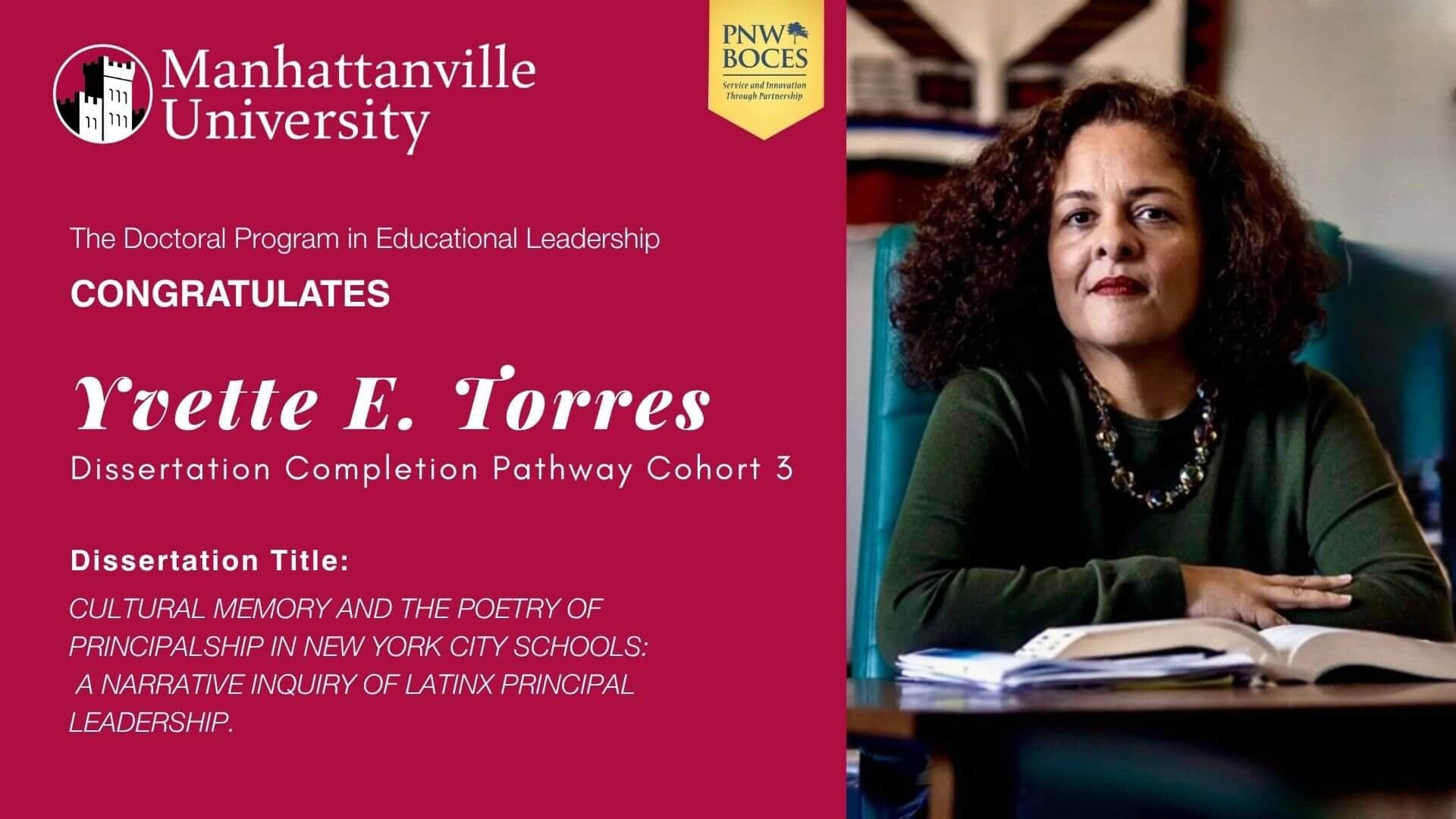
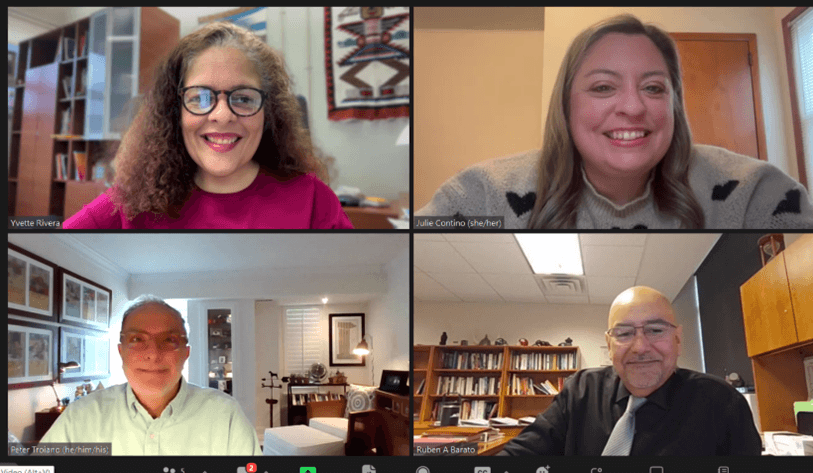
Congratulations to Yvette E. Torres, who on Monday, March 23, 2026, successfully defended her dissertation.
The title of Yvette’s dissertation is "CULTURAL MEMORY AND THE POETRY OF PRINCIPALSHIP IN NEW YORK CITY SCHOOLS: A NARRATIVE INQUIRY OF LATINX PRINCIPAL LEADERSHIP."
Overview of Problem: Latinx school leaders often maintain a sustained connection to their cultural heritage, which shapes how they interpret and enact leadership within schools. Cultural heritage and values, linguistic awareness, community knowledge, and lived experiences function as forms of experiential knowledge that inform decision-making, advocacy, and relationship-building. These culturally grounded perspectives enable leaders to foster relational trust and credibility among students, families, and staff while advocating for equity within complex urban school systems.
Research Purpose: This study explores the extent to which Latinx school leaders experience their cultural heritage as a resource or barrier in their leadership work within New York City schools.
Theoretical Framework and Research Design: Guided by Latina/o Critical Race Theory (LatCrit), this qualitative study employs narrative inquiry to examine how cultural heritage shapes power and leadership work. LatCrit centers experiential knowledge and cultural capital as legitimate sources of insight into institutional inequities. Narrative inquiry, informed by Clandinin and Connelly’s three-dimensional framework of interaction, continuity, and situation, provides the methodological approach for examining participants’ leadership stories.
Sample: Purposeful sampling was used to recruit five Latinx principals working in New York City schools.
Data Collection and Analysis: Data were collected through two rounds of semi-structured narrative interviews that invited participants to reflect on leadership experiences across time, relationships, and institutional contexts. Participants also composed redondilla poems as reflective artifacts, which served as complementary narrative texts and expressions of cultural memory. Data analysis was guided by the dimensions of temporality, sociality, and place. Open coding identified significant narrative segments, followed by focused coding and cross-case analysis to identify shared themes while preserving individual narrative integrity.
Findings and Implications: Findings indicate that cultural heritage serves as a foundation for leadership identity, relational practice, and strategic decision-making. Participants drew upon family teachings, lived experiences, and community-based knowledge to guide leadership while navigating dominant organizational norms. The study suggests that culturally grounded leadership is central to equity-focused principalship, and that leadership preparation programs and district policy should recognize experiential knowledge, relational care, and community cultural wealth as core competencies that strengthen educational leadership.
DISSERTATION COMMITTEE CHAIR:
Dr. Peter F. Troiano
DISSERTATION COMMITTEE MEMBER(S):
Dr. Ruben Barato
Dr. Julie Contino
Take Your Career to the Next Level
Elevate your leadership skills, deepen your understanding of critical and contemporary education issues, and learn to help solve the current challenges in P-20 education.
Learn to Inspire Change
The Doctoral Program in Educational Leadership from Manhattanville, offered in partnership with Putnam Northern Westchester BOCES, utilizes a forward-thinking approach to educational leadership that is ideal for practicing and aspiring leaders in any educational context. It is designed to support the goals of educational professionals who seek to develop their leadership skills for career advancement or current job enhancement.