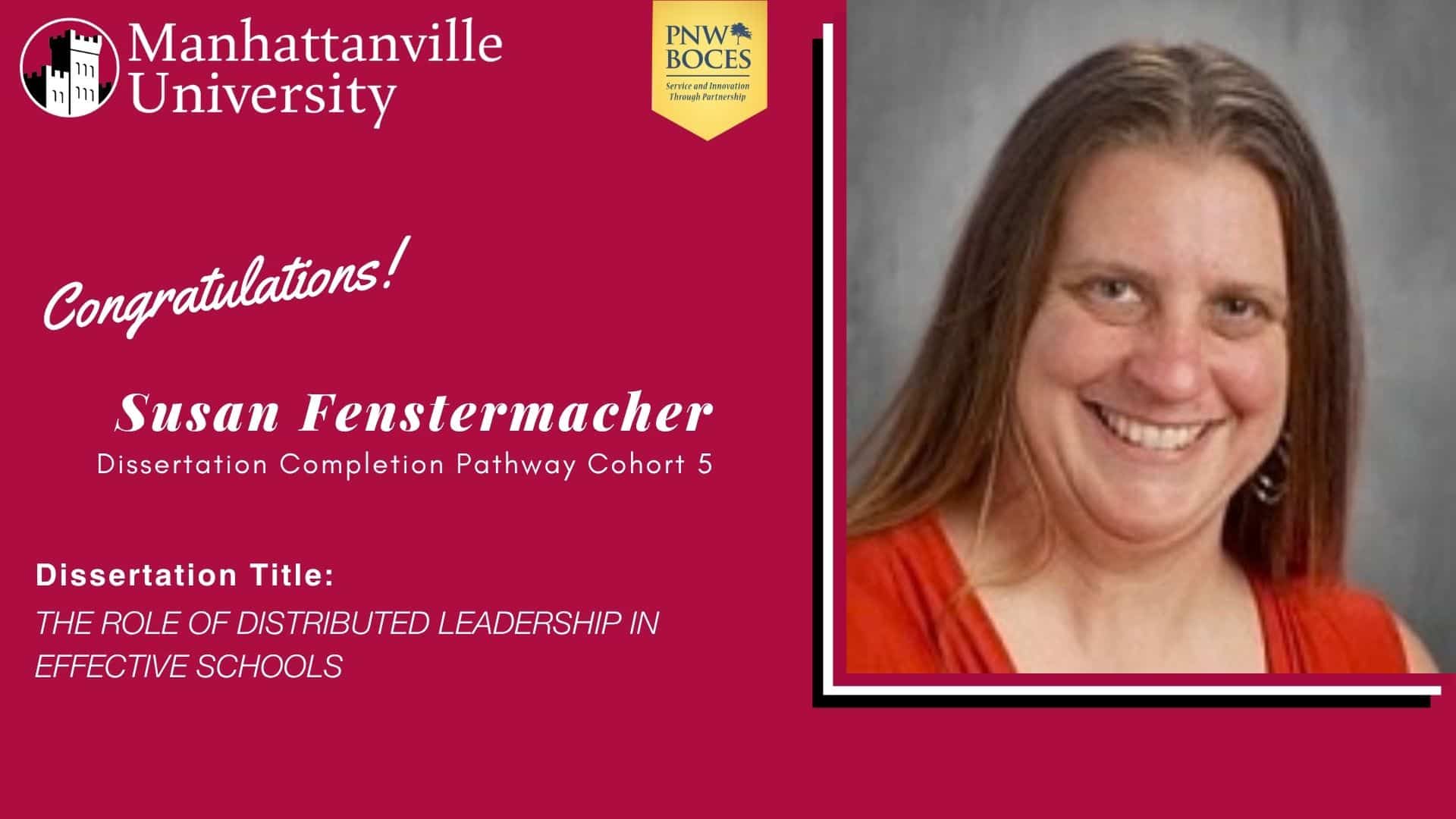
Congratulations to Susan Fenstermacher, who on Friday, September 25, 2026, successfully defended her dissertation.
The title of Susan's dissertation is, "THE ROLE OF DISTRIBUTED LEADERSHIP IN EFFECTIVE SCHOOLS."
The abstract of this study follows:
Overview of the Problem: Many U.S. schools still rely on top-down leadership structures that may not reflect the complex demands of modern education. Although distributed leadership offers a collaborative alternative, limited U.S. based research has examined how its components relate to perceived school effectiveness.
Research Purpose: This study examined the relationship between distributed leadership, specifically collaboration, shared responsibility, and leadership distribution, and perceived school effectiveness among PK - 12 educators in the United States.
Research Design: A quantitative study, cross-sectional, correlation survey design was used.
Sample: Participants included 106 PK–12 educators and school-based staff from public, charter, private, and parochial schools. The sample represented varied roles, school levels, district sizes, and urban, suburban, and rural settings.
Data Collection and Analysis: Data were collected through an online survey using the Distributed Leadership Inventory and School Effectiveness Questionnaire. Descriptive statistics summarize participant characteristics and variables. Pearson correlation, multiple regression, and moderation analyses examined relationships among the variables.
Findings/Results: Distributed leadership had a statistically significant positive relationship with perceived school effectiveness. Each leadership dimension significantly predicted perceived school effectiveness independently. Collaboration was the strongest predictor, followed by shared responsibility and leadership distribution. When entered simultaneously, collaboration was the only significant, unique predictor. School size, type, level, geographic setting, and participant role did not significantly moderate the relationship.
Conclusions/Implications: Findings suggest that collaboration is important to perceptions of school effectiveness. Educational leaders, policymakers, and preparation programs should support collaborative structures, teacher leadership opportunities, and shared responsibility across diverse educational settings
Dissertation Committee Chair:
Dr. Nora C. R. Broege
Dissertation Committee Members:
Dr. Shelley Wepner
Dr. Robert D. Feirsen

Take Your Career to the Next Level
Elevate your leadership skills, deepen your understanding of critical and contemporary education issues, and learn to help solve the current challenges in P-20 education.
Learn to Inspire Change
The Doctoral Program in Educational Leadership from Manhattanville, offered in partnership with Putnam Northern Westchester BOCES, utilizes a forward-thinking approach to educational leadership that is ideal for practicing and aspiring leaders in any educational context. It is designed to support the goals of educational professionals who seek to develop their leadership skills for career advancement or current job enhancement.