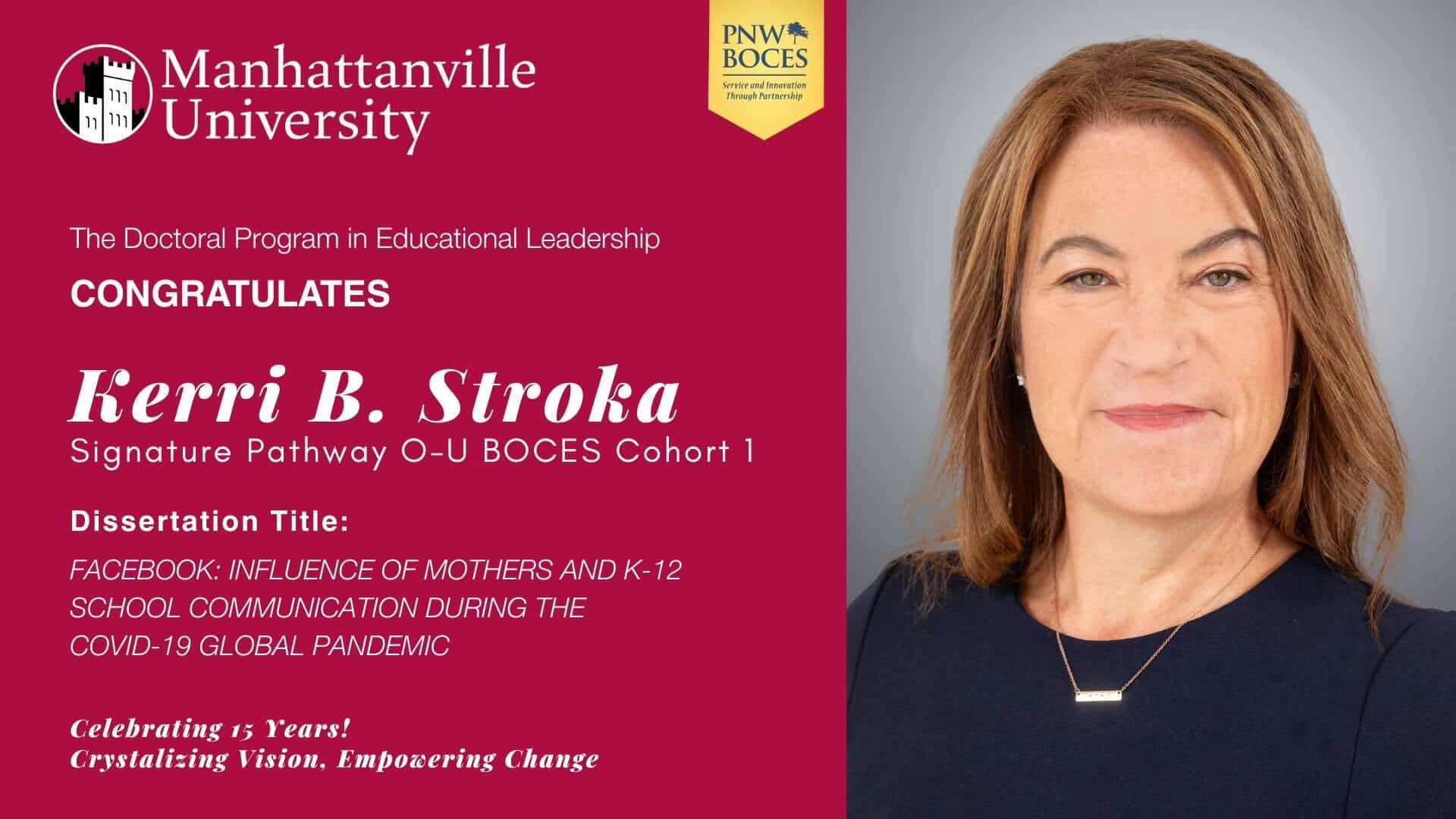
Congratulations to Kerri B. Stroka who on Tuesday, December 9, 2026, successfully defended her dissertation.
The title of Kerri’s dissertation is, "FACEBOOK: INFLUENCE OF MOTHERS AND K-12 SCHOOL COMMUNICATION DURING THE COVID-19 GLOBAL PANDEMIC."
Overview of Problem: The COVID-19 global pandemic created unprecedented educational disruption, requiring school district administrators to implement remote learning with minimal preparation. As traditional in-person communication channels were halted, social media platforms, particularly Facebook, emerged as critical spaces where mothers sought information, built community, and advocated for their children’s educational needs. This digital shift fundamentally altered power dynamics between parents and school districts, creating contested spaces where educational policies and decisions were publicly challenged and negotiated.
Research Purpose: This interpretive qualitative study examined how mothers used Facebook as a platform for educational advocacy during the COVID-19 global pandemic and the extent to which their online engagement influenced school district administrators’ decision-making processes. Employing contested space theory as the theoretical framework, this research examined how Facebook groups, particularly Mothers of New York, functioned as digital arenas where traditional power dynamics between parents and educational institutions were negotiated and challenged during unprecedented school closures, and how administrators monitored, interpreted, and responded to emerging parent advocacy networks during the initial pandemic response.
Research Design: This study utilized an interpretive qualitative approach with triangulated data collection methods. Data sources included semistructured interviews with K-12 school administrators from the Hudson Valley in New York, content analysis of Facebook posts from the Mothers of New York group, and examination of district communications from March through October 2020.
Sample: Fourteen purposively selected school district administrators (principals, assistant superintendents, and superintendents) from Hudson Valley districts who held decision-making positions during the COVID-19 global pandemic participated in the study.
Data Collection and Analysis: Data collection employed semistructured interviews lasting 45-60 minutes, systematic collection of Facebook posts and comment threads, and analysis of district communication documents. Qualitative data analysis software facilitated coding of interview transcripts, Facebook posts, and district documents to identify key themes and patterns.
Findings/Results: Four major themes emerged: Initial Denial, Informal Intelligence Networks, Setting the Record Straight, and Evolution from Reactive to Proactive. Findings revealed administrators initially resisted engaging with social media but increasingly relied on informal networks to monitor parent discourse. Digital platforms enabled mothers to coordinate messaging and challenge institutional authority, compelling administrators to develop strategic responses and evolve from reactive crisis management to proactive communication approaches.
Conclusions/Implications: This study contributes to understanding stakeholder engagement in educational leadership during crisis situations and informs future communication strategies between school districts and parents. As social media continues transforming civic engagement in educational contexts, findings illuminate how contested digital spaces reshape traditional power relationships in K-12 education.
DISSERTATION COMMITTEE CHAIR(S):
Dr. Kenneth Mitchell
DISSERTATION COMMITTEE MEMBER(S):
Dr. Yiping Wan
Dr. Frank Zamperlin


Take Your Career to the Next Level
Elevate your leadership skills, deepen your understanding of critical and contemporary education issues, and learn to help solve the current challenges in P-20 education.
Learn to Inspire Change
The Doctoral Program in Educational Leadership from Manhattanville, offered in partnership with Putnam Northern Westchester BOCES, utilizes a forward-thinking approach to educational leadership that is ideal for practicing and aspiring leaders in any educational context. It is designed to support the goals of educational professionals who seek to develop their leadership skills for career advancement or current job enhancement.