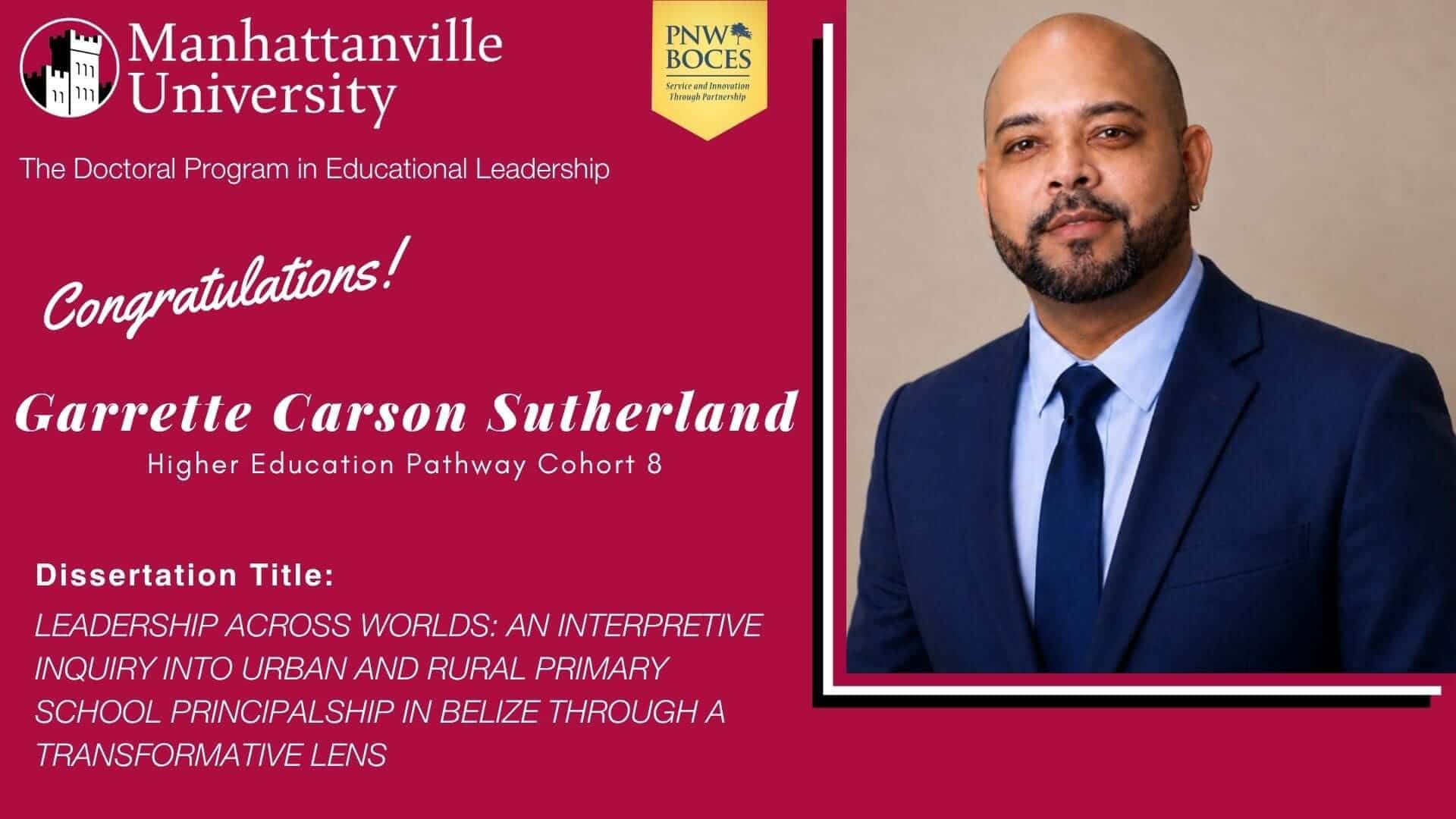
Congratulations to Garrette Carson Sutherland, who on Wednesday, July 29, 2026, successfully defended his dissertation.
The title of Garrette's dissertation is, "LEADERSHIP ACROSS WORLDS: AN INTERPRETIVE INQUIRY INTO URBAN AND RURAL PRIMARY SCHOOL PRINCIPALSHIP IN BELIZE THROUGH A TRANSFORMATIVE LENS."
The abstract of this study follows:
Overview of Problem: Belize continues to pursue equity and quality in education; however, school leadership differs across urban and rural communities. Although principals operate under the same national policies, they lead within uneven conditions related to staffing, technology, resources, and multigrade teaching. Leadership preparation and support systems do not always account for these differences, leaving limited empirical understanding of how principals enact leadership across contexts.
Research Purpose: Guided by Transformational Leadership Theory, this study explored how Belizean primary school principals conceptualized and enacted leadership in urban and rural settings and how context shaped their challenges, relationships, decisions, and improvement practices.
Research Design: An interpretive qualitative design examined principals’ lived experiences and meaning-making through the lens of transformational leadership.
Sample: The sample consisted of 16 principals – eight urban and eight rural – from Belize’s six districts. Participants were selected through purposive maximum-variation sampling and had at least three years of principalship experience.
Data Collection and Analysis: Data were collected through semi-structured interviews, a demographic form, and a reflexive journal. Interviews were transcribed verbatim, anonymized, and organized in Delve. Analysis followed Yin’s five-phase cycle of qualitative data analysis. In Vivo Coding preserved participants’ language, after which related codes were organized into broader categories and themes. The Four I’s of transformational leadership served as sensitizing concepts, helping to examine the emergent themes. Cross-participant comparisons were conducted to examine similarities and differences between urban and rural principals’ experiences.
Findings/Results: Six themes emerged: collaborative, human-centered leadership; teacher development and support; community and parent partnerships; vision-driven improvement; contextual constraints and adaptation; and service, humility, resilience, and moral responsibility. Urban principals described pressures associated with larger schools, administrative demands, visibility, and parent expectations. Rural principals more often described teaching-principal responsibilities, multigrade realities, limited infrastructure, geographic isolation, and dependence on community support. Across contexts, principals emphasized relationships, shared responsibility, teacher support, vision, service, and resourcefulness.
Conclusions/Implications: Transformational leadership highlighted principals’ vision, motivation, modeling, and individualized support but did not fully capture the service-oriented and context-dependent dimensions of their work. The findings support context-responsive principal preparation, mentorship, community engagement, adaptive problem-solving, and well-being supports for urban and rural realities.
Dissertation Chair:
Dr. Shelley B. Wepner
Dissertation Committee Members:
Dr. Yiping Wan
Dr. Lynn Allen

Take Your Career to the Next Level
Elevate your leadership skills, deepen your understanding of critical and contemporary education issues, and learn to help solve the current challenges in P-20 education.
Learn to Inspire Change
The Doctoral Program in Educational Leadership from Manhattanville, offered in partnership with Putnam Northern Westchester BOCES, utilizes a forward-thinking approach to educational leadership that is ideal for practicing and aspiring leaders in any educational context. It is designed to support the goals of educational professionals who seek to develop their leadership skills for career advancement or current job enhancement.