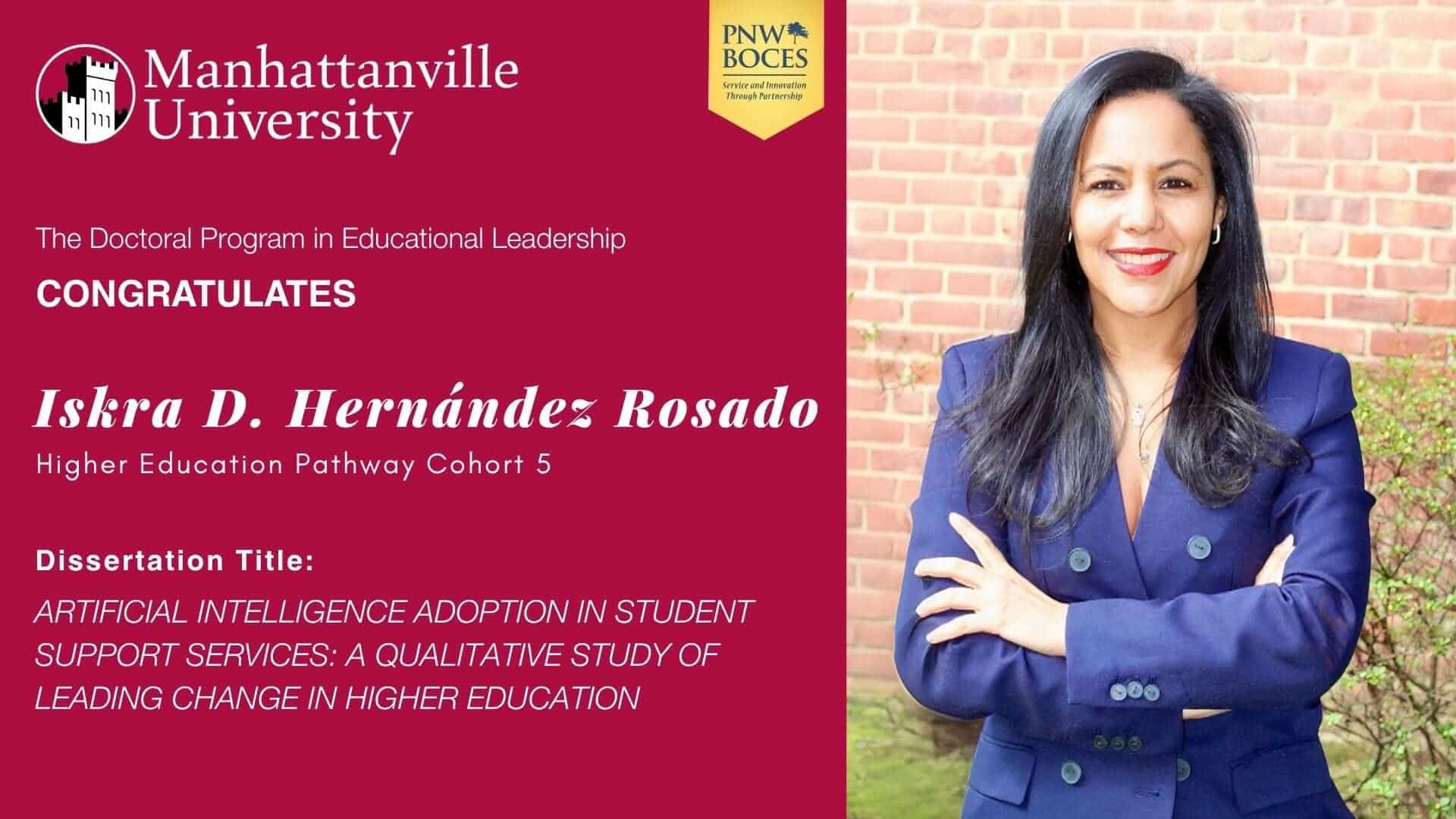
Congratulations to Iskra D. Hernández Rosado who on Thursday, April 16,2026 successfully defended her dissertation.
The title of Iskra’s dissertation is "ARTIFICIAL INTELLIGENCE ADOPTION IN STUDENT SUPPORT SERVICES: A QUALITATIVE STUDY OF LEADING CHANGE IN HIGHER EDUCATION."
Overview of Problem: Higher education institutions face existential threats from financial deficits and shifting demographics. To alleviate these pressures, leaders are adopting AI in Student Support Services (SSS). However, AI integration introduces high costs, ethical risks, and cultural resistance. Consequently, there is a critical gap in understanding how administrators practically navigate these immense complexities.
Research Purpose: The purpose of this qualitative study was to describe how higher education leaders managed organizational change as they navigated integrating generative and agentic AI into student support services.
Research Design: The study employed a qualitative, interpretive design. The inquiry was anchored by Lewin’s (1947) change model and Heifetz’s (1994) theory of adaptive leadership.
Sample: I employed a purposeful sampling strategy, alongside maximum variation and snowball sampling. The final sample consisted of 12 higher education leaders.
Data Collection and Analysis: Data were collected through virtual, semi-structured interviews and analyzed using Creswell’s (2017) framework. Analysis integrated Lewin’s coding strategies, Saldaña and Omasta’s (2018) in vivo and values coding, and Merriam and Grenier’s (2019) constant comparative method. The interviews explored change management strategies, staff concerns, and sustainability processes.
Findings: The study found that leaders successfully navigated integration by using data to create urgency and destabilize the status quo. They cultivated a culture of psychological safety to manage staff anxiety. Administrators also addressed adaptive challenges, including algorithmic opacity. Ultimately, they secured buy-in by framing AI as an administrative tool that protects empathetic student care and human connection.
Conclusions/Implications: Survival in the AI era depends on leadership's adaptive capacity, not software sophistication. Integrating AI is a profound cultural shift. Leaders must act as ethical gatekeepers and reframe automation as a human-centered protector. By automating rote tasks, institutions free staff to provide high-touch care, successfully aligning innovation with enduring humanistic values.
Dissertation Committee Chair:
Dr. Susan V. Iverson
Dissertation Committee Members:
Dr. Robert Mangione
Dr. Rubén Barato

Take Your Career to the Next Level
Elevate your leadership skills, deepen your understanding of critical and contemporary education issues, and learn to help solve the current challenges in P-20 education.
Learn to Inspire Change
The Doctoral Program in Educational Leadership from Manhattanville, offered in partnership with Putnam Northern Westchester BOCES, utilizes a forward-thinking approach to educational leadership that is ideal for practicing and aspiring leaders in any educational context. It is designed to support the goals of educational professionals who seek to develop their leadership skills for career advancement or current job enhancement.