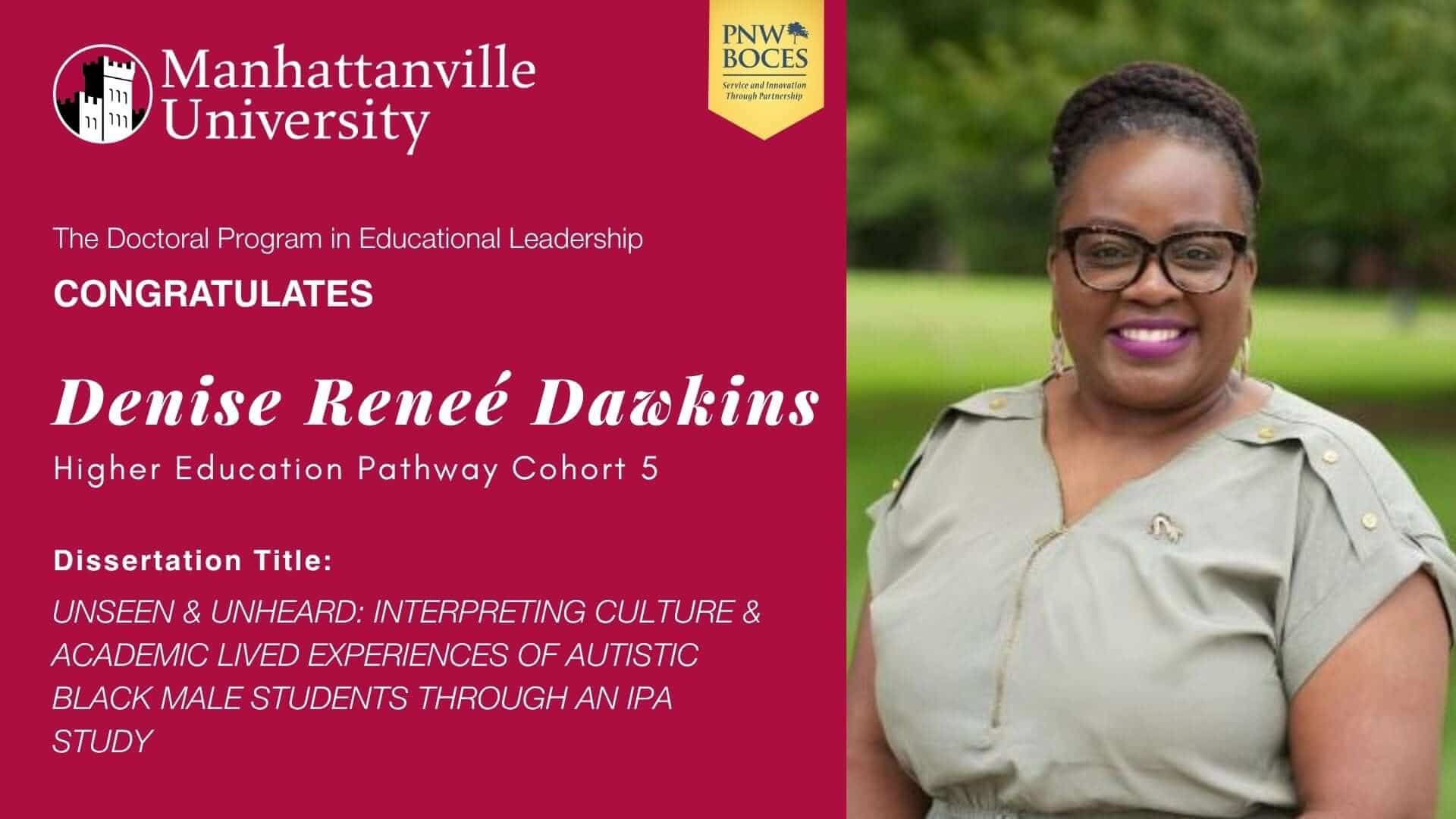
Congratulations to Denise Reneé Dawkins who on Tuesday April 14, 2026, successfully defended her dissertation.
The title of Denise’s dissertation is, "UNSEEN & UNHEARD: INTERPRETING CULTURE & ACADEMIC LIVED EXPERIENCES OF AUTISTIC BLACK MALE STUDENTS THROUGH AN IPA STUDY."
Overview of Problem: Studies have revealed autism spectrum disorder is rapidly growing, more so in males than females yet minority Autistic communities are invisible in research. Learning best practices to support and provide adequate resources to this community is crucial.
Research Purpose: The purpose for this qualitative study is to explore how Autistic Black male students and navigate through academic and social experiences. In particular, I focus on transitions as they maneuver through academic and socioemotional journeys seeking support, intellect, and understanding.
Research Design: Utilizing Interpretative Phenomenological Analysis, this research investigates the social and academic transitions of Autistic Black male students. The study integrates Transition Theory and Culturally Responsive Pedagogy to provide a deep understanding of their unique lived experiences.
Sample: Six Autistic Black males between the age group of 21-29. Participants were recruited by colleagues, social media, snowball sampling, disability – emphasizing minority autistic support groups, and collegiate accommodations offices.
Data Collection and Analysis: Data was collected though semi-conversational interviews with participants and analyzed interpretive phenomenological analysis. Interviews explored their lived experiences and development of academic and social identities. This led to the emergence of four themes: cultural understanding; struggling with support; challenges; the journey.
Findings/Results: While participants exhibited varying levels of resilience toward systemic challenges, their collective narratives underscore a plea for enhanced community assessments and sustained opportunities for self-discovery. This research highlights how restricted access to support manifests as frustration and a sense of being “unseen or unheard”. Consequently, these findings advocate for expanded research that centers the voices of minoritized autistic individuals and the development of institutional infrastructures that support them.
Conclusions/Implications: By extending the theories of Gay and Ladson-Billings, this research demonstrates that for Autistic Black males, academic persistence is inseparably linked to a “motherly pedagogy” characterized by support and warmth rather than rigidity and institutional ableism. This demands that institutions shift the burden of change away from the student, reframing neurodiversity and Blackness as strengths. Ultimately, by integrating inclusionary supportive measures with academic services educators can restore student’s self-concept, transforming the classroom from a site of survival into a pathway for success.
Dissertation Committee Chair(s):
Dr. Nora Broege
Dissertation Committee Member(s):
Dr. Martin Fitzgerald
Dr. Vivienne Felix
Take Your Career to the Next Level
Elevate your leadership skills, deepen your understanding of critical and contemporary education issues, and learn to help solve the current challenges in P-20 education.
Learn to Inspire Change
The Doctoral Program in Educational Leadership from Manhattanville, offered in partnership with Putnam Northern Westchester BOCES, utilizes a forward-thinking approach to educational leadership that is ideal for practicing and aspiring leaders in any educational context. It is designed to support the goals of educational professionals who seek to develop their leadership skills for career advancement or current job enhancement.