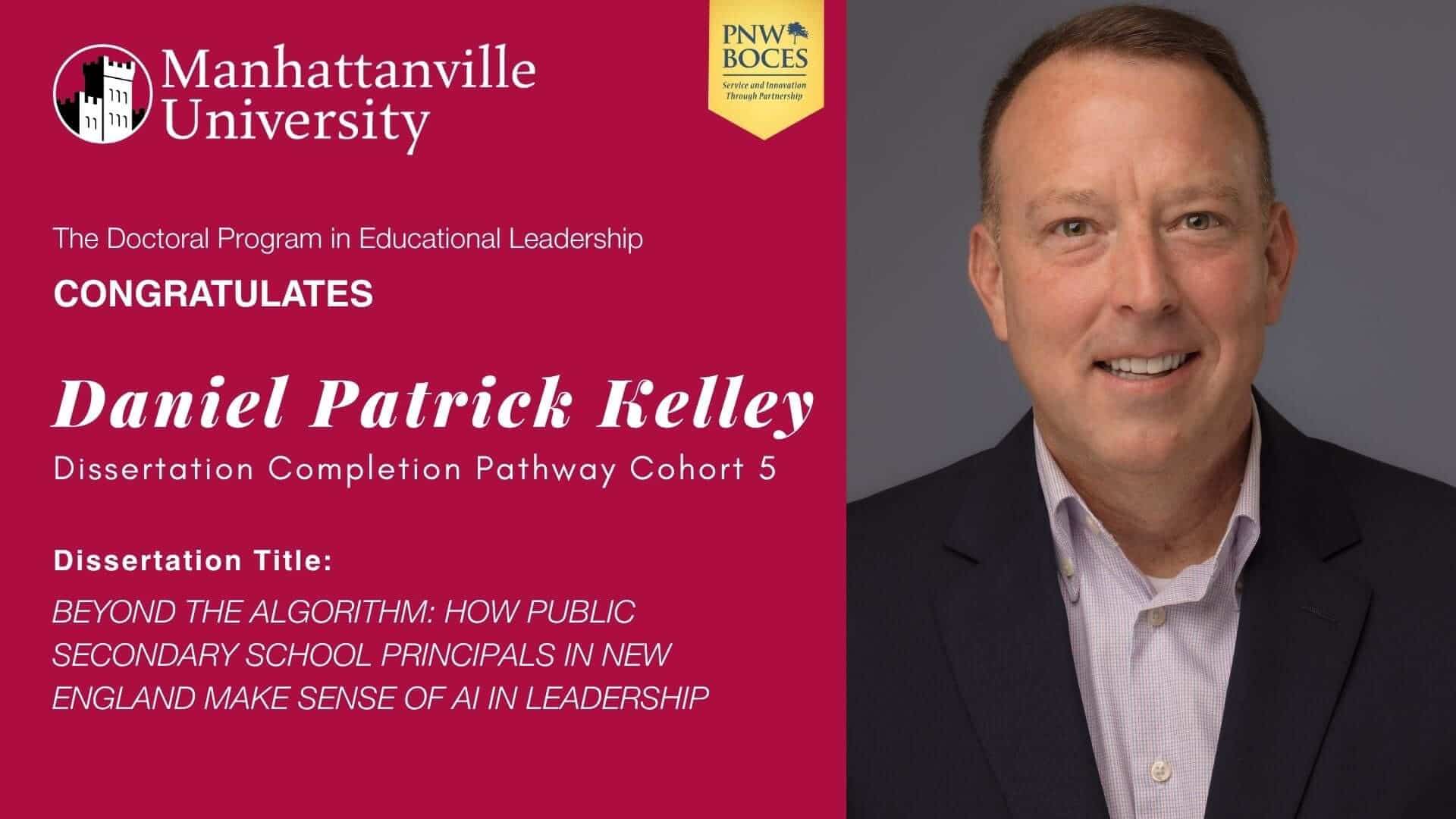
Congratulations to Daniel Patrick Kelley who on Friday, April 10, 2026, successfully defended his dissertation.
The title of Dan’s dissertation is, "BEYOND THE ALGORITHM: HOW PUBLIC SECONDARY SCHOOL PRINCIPALS IN NEW ENGLAND MAKE SENSE OF AI IN LEADERSHIP."
Overview of Problem: The rapid emergence of generative artificial intelligence (AI) has introduced new opportunities and challenges for K–12 educational leadership. While existing research has largely focused on classroom applications, there is limited understanding of how school principals interpret and integrate AI into their leadership practice. In the absence of clear policy guidance and amid increasing role complexity, principals must navigate ethical, professional, and organizational tensions related to AI use.
Research Purpose: The purpose of this interpretive qualitative study, grounded in Weick’s Sensemaking Theory, was to examine how secondary school principals in New England perceive, adopt, and integrate generative artificial intelligence into their leadership practice, and how they construct meaning around its use within complex educational environments.
Research Design: This study employed an interpretive qualitative research design informed by Sensemaking Theory to explore how principals interpret and act upon emerging AI technologies in their professional contexts.
Sample: A purposeful sample of 19 public secondary school principals from across five New England states, representing a range of experience levels and school contexts, including urban, suburban, and rural settings. All participants had at least three years of leadership experience and demonstrated engagement with generative AI tools in their professional practice.
Data Collection and Analysis: Data were collected through semi-structured interviews and analyzed using an iterative coding process and thematic analysis, supported by analytic memos and reflexive journaling.
Findings/Results: Five themes emerged: (1) principals used AI to offload managerial tasks and protect leadership capacity; (2) they established “red lines” to preserve authenticity and credibility; (3) they constructed localized governance in the absence of formal policy; (4) they engaged in informal, practice-based learning through experimentation and peer networks; and (5) they navigated strategic disclosure of AI use to manage relational trust and professional risk.
Conclusions/Implications: Findings suggest that principals’ engagement with AI is an interpretive and relational leadership process rather than a purely technical task. The study highlights the need for leadership preparation programs, policy frameworks, and professional learning that support ethical decision-making, adaptive leadership, and context-responsive AI integration.
Dissertation Committee Chair(s):
Dr. Martin Fitzgerald
Dissertation Committee Member(s):
Dr. Robert Feirsen
Dr. Jennifer Harriton-Wilson

Take Your Career to the Next Level
Elevate your leadership skills, deepen your understanding of critical and contemporary education issues, and learn to help solve the current challenges in P-20 education.
Learn to Inspire Change
The Doctoral Program in Educational Leadership from Manhattanville, offered in partnership with Putnam Northern Westchester BOCES, utilizes a forward-thinking approach to educational leadership that is ideal for practicing and aspiring leaders in any educational context. It is designed to support the goals of educational professionals who seek to develop their leadership skills for career advancement or current job enhancement.