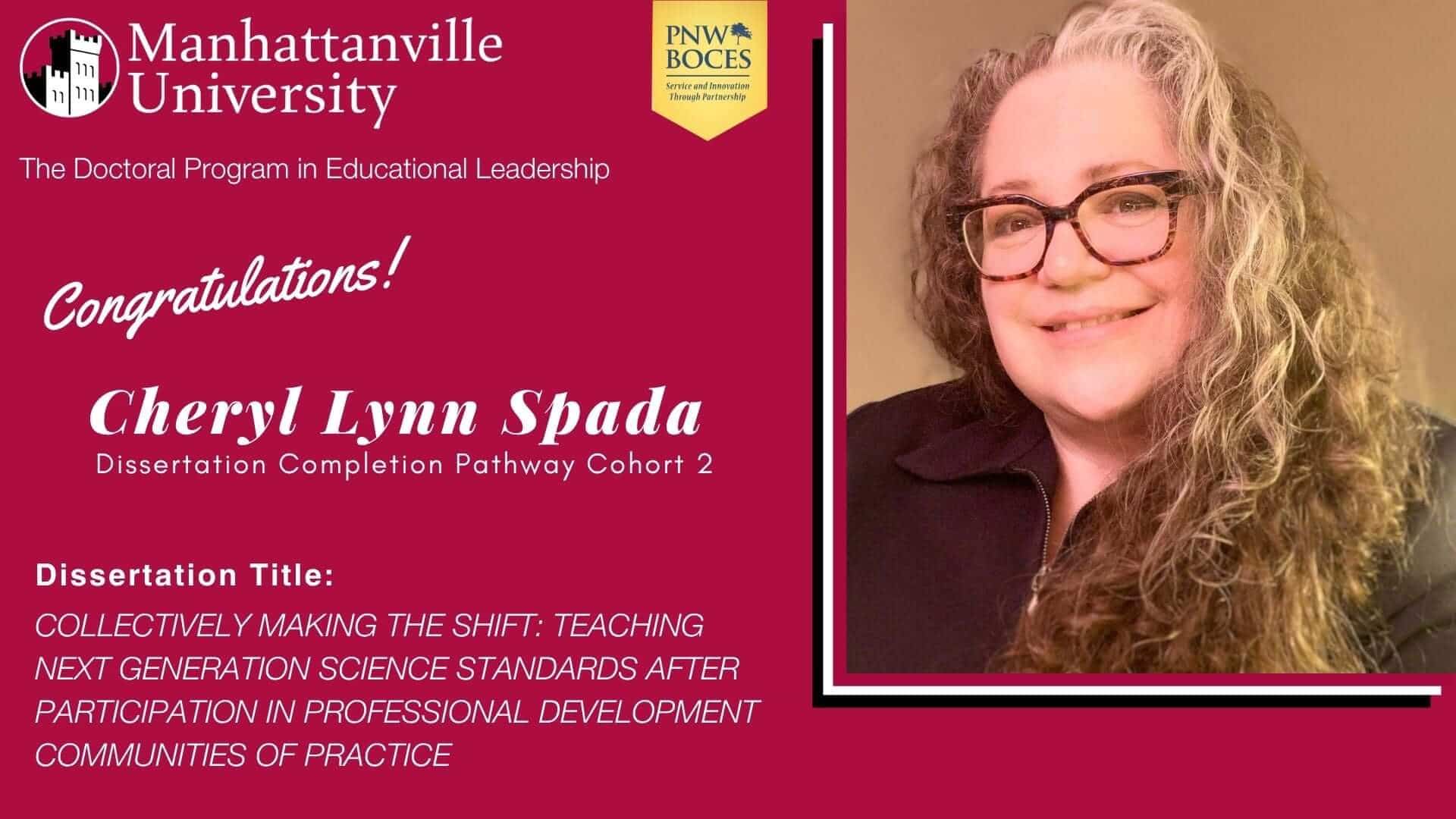
Congratulations to Cheryl Lynn Spada who on Thursday, May 21, 2026, successfully defended her dissertation.
The title of Cheryl’s dissertation is, "COLLECTIVELY MAKING THE SHIFT: TEACHING NEXT GENERATION SCIENCE STANDARDS AFTER PARTICIPATION IN PROFESSIONAL DEVELOPMENT COMMUNITIES OF PRACTICE."
Overview of Problem: The Next Generation Science Standards (NGSS) ushered sweeping changes in K–12 science teaching via its three-dimensional learning model. Teaching NGSS with fidelity requires a paradigm shift in practices promoting student-driven use of authentic science and engineering practices and understanding coherent ideas across four disciplinary core ideas.
Research Purpose: The purpose of this qualitative research was to articulate any changes in classroom pedagogical practices of K–12 science teachers who participated in a year-long professional development community of practice focused on the three-dimensional learning model of NGSS.
Research Design: A qualitative multiple case study design was employed via two semi-structured interviews coupled with analysis of classroom artifacts. Situated learning theory, as described by Lave and Wenger (1991) was the theoretical framework, exploring learning as a domain of social practice, situated in the context in which it’s acquired.
Sample: Two levels of purposeful sampling took place. First, members of a state-sponsored Master Teacher Program who were members of a PLT focusing on NGSS were selected. Next, information-rich cases from primary (K–6), and secondary (7–12) levels were identified.
Data Collection and Analysis: Two rounds of semi-structured virtual interviews were conducted via Zoom between November 2025 and March 2026 to explore participants’ experiences and meaning-making based on participation in NGSS-focused PLTs. Participants were asked to provide artifacts for review and analysis between the two interviews.
Findings/Results: A cross-case qualitive analysis was employed leading to identification of five emergent themes: (a) administration and teacher agency in pedagogical decision-making, (b) cultivating ownership and authority through communities of practice, (c) pedagogical mastery, (d) meaning making, (e) refined and reflexive professional judgement.
Conclusions/Implications: The collaborative environment of out-of-district, long-term communities of practice drove meaningful development of pedagogical content knowledge, teacher self-efficacy and teacher expertise, functioning as the main site for teacher-directed capacity-building and reflexiveness. Therefore, on-going collaborative learning teams of science teacher-practitioners collectively grappling with real-world complexities of the NGSS three-dimensional learning model should be supported due to their positive impact on teacher pedagogical practices.
Dissertation Committee Chair(s):
Dr. Peter Troiano
Dissertation Committee Member(s):
Dr. Yiping Wan
Dr. Angela Pagano

Take Your Career to the Next Level
Elevate your leadership skills, deepen your understanding of critical and contemporary education issues, and learn to help solve the current challenges in P-20 education.
Learn to Inspire Change
The Doctoral Program in Educational Leadership from Manhattanville, offered in partnership with Putnam Northern Westchester BOCES, utilizes a forward-thinking approach to educational leadership that is ideal for practicing and aspiring leaders in any educational context. It is designed to support the goals of educational professionals who seek to develop their leadership skills for career advancement or current job enhancement.